
Updated on 26 October, 2026
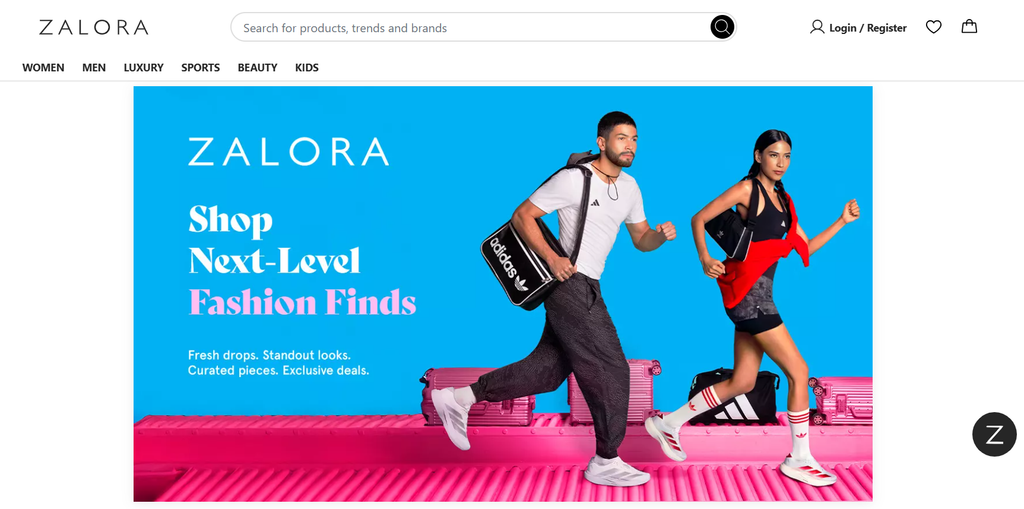
ZALORA is an online fashion and lifestyle platform founded in 2012. Part of Global Fashion Group (GFG), the company connects consumers with international and local brands through its e-commerce platform, offering products across apparel, footwear, accessories, beauty, sportswear, and lifestyle categories.
ZALORA operates across Southeast Asia, with a presence in Singapore, Indonesia, Malaysia, the Philippines, and Hong Kong. Its business model combines online retail, third-party marketplace services, logistics, marketing, and technology solutions for fashion brands.
Unlike traditional retailers that depend primarily on purchasing and reselling inventory, ZALORA operates through multiple commercial models. It can purchase products from brands and sell them directly, host third-party sellers on its marketplace, and provide brands with services that support their e-commerce operations.
This combination allows ZALORA to serve both consumers looking for convenient online shopping and businesses seeking access to Southeast Asia's digital fashion market.
In March 2026, ZALORA introduced its new regional brand platform, Got You Looking, reflecting its continued focus on fashion discovery, customer engagement, and partnerships. The company remains part of Global Fashion Group, which also operates THE ICONIC in Australia and New Zealand and Dafiti in Latin America.
This article examines ZALORA's current business model, revenue streams, operating costs, competitive advantages, and the challenges it faces in Southeast Asia's increasingly competitive e-commerce market.
When ZALORA launched in 2012, its business was primarily associated with online fashion retail. The company invested in brand partnerships, inventory, warehousing, marketing, and delivery infrastructure to make fashion products more accessible to online shoppers.
As the regional e-commerce market matured, ZALORA expanded beyond direct retail into a broader platform model.
Today, its business combines wholesale retail and third-party marketplace operations. Under the wholesale model, ZALORA purchases products from suppliers, stores them in its warehouses, and sells them to customers. Under the marketplace model, third-party sellers can list products on ZALORA while retaining varying levels of control over inventory, pricing, and fulfilment.
The company has also developed business-to-business services that help brands manage and expand their online operations. These include e-fulfilment, multi-channel logistics, e-distribution, data services, and marketing solutions.
This evolution is significant because it allows ZALORA to generate value from more than the sale of fashion products. Its infrastructure, regional knowledge, technology, and customer reach can also be monetised through services provided to brand partners.
Official source: ZALORA Corporate – E-Commerce Solutions
For consumers, ZALORA offers a convenient destination for discovering and purchasing fashion and lifestyle products from a range of local and international brands. Customers can browse different categories, compare products, access promotions, choose from available payment methods, and arrange delivery through one platform.
Returns and delivery benefits depend on the relevant market, order value, and applicable terms. These services help reduce the uncertainty associated with buying clothing and footwear online.
For brands, ZALORA provides access to an established e-commerce audience without requiring every partner to build its own regional infrastructure. Depending on the partnership model, brands can use ZALORA's marketplace, warehousing, fulfilment, marketing capabilities, and customer insights.
This dual value proposition is central to the business. Consumers receive a convenient shopping experience, while brand partners gain access to customers and services that can support their online growth.
ZALORA serves consumers who shop online for fashion, beauty, sportswear, accessories, and lifestyle products. Its audience includes shoppers with different budgets, styles, purchasing habits, and brand preferences.
On the business side, ZALORA serves international fashion labels, local designers, distributors, and merchants seeking to expand their online presence in Southeast Asia.
These two customer groups reinforce one another. A broader selection of brands can attract more shoppers, while greater consumer demand makes the platform more valuable to sellers.
ZALORA's operations involve product merchandising, brand acquisition, marketplace management, digital marketing, customer service, inventory planning, warehouse operations, order fulfilment, and returns management.
Its business-to-business activities also include managing e-commerce stores, coordinating multi-channel fulfilment, developing marketing campaigns, and providing data-driven insights to brand partners.
Technology is important across these activities. Product recommendations, customer analytics, inventory visibility, and operational systems can improve the shopping experience while helping the company manage costs.
ZALORA's key resources include its e-commerce platform, brand relationships, customer data, fulfilment infrastructure, technology, and employees with expertise in fashion retail and regional e-commerce.
Its partners include fashion brands, suppliers, marketplace sellers, payment providers, logistics companies, and technology service providers. As part of Global Fashion Group, ZALORA can also draw on regional e-commerce expertise and shared capabilities that support its operations.
ZALORA primarily reaches consumers through its website and mobile application. Digital advertising, promotional campaigns, personalised recommendations, email communications, and social media also support customer acquisition and retention.
For brand partners, ZALORA provides business-facing services through its corporate platform, seller tools, account management, and e-commerce solutions.
The company must maintain a balance between attracting new shoppers and encouraging existing customers to return. In fashion e-commerce, customer retention depends not only on discounts but also on product availability, authenticity, delivery reliability, customer service, and the ease of returns.
ZALORA's cost structure includes inventory purchases, warehousing, fulfilment, delivery, returns, technology, employee expenses, marketing, and customer service.
The wholesale model requires capital to purchase inventory and creates the risk of unsold products, markdowns, and changing fashion trends.
The marketplace model can reduce the need for ZALORA to purchase every item it lists. However, it still requires investment in platform development, seller support, customer acquisition, payment processing, quality control, and the broader marketplace experience. Developing third-party services introduces additional operating costs but can also improve the utilisation of ZALORA's existing infrastructure.
ZALORA's revenue model consists of several complementary streams. The main distinction is between revenue generated from selling products and revenue generated by providing services to brands and merchants.
Under the wholesale model, ZALORA purchases products from brands and suppliers, stores them, and sells them to consumers at retail prices.
The difference between the selling price and the cost of the products contributes to gross profit. However, gross profit is not the same as net profit because the company must also cover fulfilment, marketing, employee, technology, and other operating expenses.
For example, if ZALORA purchases a product for RM100 and sells it for RM180, the transaction generates RM80 in gross profit before other applicable costs, assuming the product is sold without additional discounts or adjustments.
The wholesale model allows ZALORA to control product presentation, inventory availability, and the customer experience more directly. However, it also exposes the business to inventory risk.
Fashion products can lose value quickly when trends change, seasons end, or competing retailers offer discounts. Inventory planning is therefore essential to maintaining healthy margins.
ZALORA's marketplace allows third-party brands and merchants to list products on its platform.
Instead of purchasing all the merchandise itself, ZALORA can facilitate transactions between sellers and consumers and earn revenue through agreed commercial arrangements, including commissions and related services.
The precise commission structure depends on the applicable partnership agreement and service level. It should not be assumed that all sellers pay the same rate.
ZALORA also offers different fulfilment arrangements. Sellers can manage their own inventory and order processing, or use selected ZALORA services for warehousing, logistics, and multi-channel fulfilment.
This flexibility is important because different brands have different operational capabilities. A small merchant may need extensive fulfilment support, while an established brand may only need marketplace access and marketing services.
Official source: ZALORA – Partnership Models
Fashion brands compete for customer attention, especially during product launches, seasonal campaigns, and major promotional events.
ZALORA offers marketing services that help brands reach relevant audiences through campaigns, content, and other promotional opportunities.
These services extend ZALORA's business beyond its role as a retailer. Instead of only earning from product sales, the company can also monetise its understanding of fashion consumers and its ability to connect brands with shoppers.
The value of these services depends on campaign performance, audience relevance, and the commercial arrangements agreed upon with partners.
It is important to distinguish this business from a conventional advertising-supported website. ZALORA's marketing services include brand campaigns and commercial collaborations, not simply the display of advertisements that generate revenue for every page view.
Official source: ZALORA Corporate – Marketing and E-Commerce Solutions
One of ZALORA's less visible but strategically important revenue opportunities is e-commerce infrastructure.
Fashion brands entering Southeast Asia may face challenges involving local warehousing, inventory management, shipping, returns, and cross-border operations.
ZALORA offers e-fulfilment and logistics services that allow brands to use its capabilities rather than building every operational component independently.
Its services include warehousing, multi-channel fulfilment, and local and international dropshipping arrangements, subject to the relevant market and service availability.
Multi-channel fulfilment is particularly valuable because brands may sell through their own websites and several marketplaces simultaneously. Using shared infrastructure can help them manage inventory and orders more efficiently.
For ZALORA, these services create an opportunity to generate business-to-business revenue while making better use of its existing logistics network.
Official source: ZALORA – E-Fulfilment
ZALORA also supports brands with their wider digital commerce operations.
Its e-distribution services help businesses expand their online presence through marketplace management and other digital channels. Data services can provide insights into consumer behaviour, product performance, and market opportunities.
These services address a different problem from simply selling products on ZALORA. A brand may already have an online store but lack the local expertise or operational resources to expand into additional Southeast Asian markets.
By offering these capabilities, ZALORA can position itself as an e-commerce partner rather than merely a sales channel.
This business-to-business model also creates opportunities to build longer-term relationships with brands that need ongoing operational and analytical support.
Official source: ZALORA Corporate – E-Commerce Solutions
ZALORA is part of Global Fashion Group (GFG), which reports financial performance across its broader regional businesses. Its consolidated results should not be mistaken for ZALORA's standalone revenue or profit.
According to GFG's financial results published on 4 March 2026, the group generated approximately €1.04 billion in net merchandise value and €679.8 million in revenue for the 2025 financial year.
Net merchandise value (NMV) measures the value of merchandise sold under the company's reporting definition, whereas revenue represents the amount recognised by the business. The two figures are not interchangeable.
GFG's gross margin increased from 44.9% in 2024 to 46.4% in 2025. Adjusted EBITDA improved from a loss of €17.6 million in 2024 to a positive €9.3 million in 2025.
This marked an important milestone in the group's efforts to improve profitability and operating efficiency.
However, Southeast Asia continued to face challenges. GFG reported that the region's NMV declined by 15.2% year-on-year on a constant-currency basis in 2025, while the SEA business recorded positive adjusted EBITDA of €3 million.
These results suggest that profitability and growth do not necessarily move together. A business can improve its margins and reduce costs even when sales activity remains under pressure.
For ZALORA, the broader strategic direction is relevant: maintaining operational discipline, strengthening marketplace economics, and expanding platform services can help reduce reliance on inventory-intensive retail.
Nevertheless, GFG's group-level financial results do not reveal ZALORA's individual revenue, commission rates, or standalone profitability.
Source: Global Fashion Group – FY 2025 Results
The fashion e-commerce market has become increasingly competitive. Consumers can shop through general marketplaces, social commerce platforms, brand-owned websites, and specialist fashion retailers.

This environment makes it difficult for an online retailer to compete through product selection or discounts alone.
ZALORA's expansion into marketplace and platform services represents an attempt to build value beyond direct retail sales.
A wholesale business needs to purchase and manage inventory before it can sell products. A marketplace can facilitate transactions without necessarily owning all the merchandise. A logistics or marketing service can generate additional revenue from capabilities that the company has already developed.
These models have different cost structures and risk profiles. Their relative contribution depends on transaction volumes, service demand, operating costs, and the terms of individual partnerships.
GFG's 2025 results provide evidence of the group's broader shift toward marketplace and platform services, alongside efforts to improve margins and reduce operating expenses.
The long-term opportunity is to make ZALORA's existing infrastructure useful to more brands and across more sales channels, rather than relying exclusively on the growth of its own retail transactions.
Southeast Asia consists of diverse markets with different consumer preferences, purchasing power, languages, and logistics requirements.
ZALORA's regional experience gives it an understanding of local fashion demand and the operational challenges associated with serving customers across multiple markets.
This knowledge can help international brands enter the region and help local brands reach a broader online audience.
A curated assortment of local and international brands can differentiate ZALORA from marketplaces that cover a wider range of unrelated product categories.
Brand relationships also support campaigns, product launches, and marketing collaborations that may be difficult for smaller competitors to replicate.
Warehousing, delivery, inventory management, and returns require investment and operational expertise.
ZALORA's existing infrastructure can be a competitive advantage when it is used efficiently and when brand partners value its services.
Its multi-channel fulfilment capabilities also give brands a way to coordinate operations beyond sales made directly through ZALORA.
ZALORA's combination of wholesale, marketplace, marketing, data, and logistics services creates several ways to build commercial relationships with brands.
This can increase the value of each brand partnership and create revenue opportunities beyond individual consumer purchases.
However, these advantages are not permanent. ZALORA must continue to demonstrate that its services deliver sufficient value relative to alternative marketplaces, logistics providers, and in-house brand operations.
ZALORA competes with general e-commerce marketplaces, specialist fashion retailers, brand-owned stores, and social commerce channels.
Customers can compare prices easily, while sellers can choose between several platforms. This creates pressure to offer competitive pricing, reliable delivery, attractive product selection, and a strong shopping experience.
The wholesale model exposes ZALORA to the possibility of excess inventory, seasonal markdowns, and changing consumer preferences.
Poor purchasing decisions can tie up capital and reduce gross margins. Marketplace expansion may help reduce some inventory exposure, but it does not eliminate the costs associated with operating the platform.
Digital advertising and promotional discounts can attract shoppers, but they can also become expensive.
Long-term success depends on encouraging repeat purchases through product relevance, trust, convenience, service quality, and a compelling overall experience.
GFG's 2025 results showed that its active customer base declined by 4.0% at group level, even as order frequency increased by 2.3%. These figures are not specific to ZALORA, but they highlight the importance of customer engagement and retention in online fashion retail.
Positive adjusted EBITDA at group level is an important development, but it does not mean every region or business unit is profitable on the same basis.
ZALORA must continue to manage fulfilment costs, returns, marketing expenditure, technology investments, and inventory carefully while protecting customer experience.
Expanding across Southeast Asia requires adaptation to local payment methods, consumer preferences, regulations, delivery networks, and commercial practices.
A strategy that works in one country may not work equally well in another. Regional expansion therefore requires local knowledge and disciplined execution.
ZALORA's evolution offers several lessons for entrepreneurs building e-commerce and platform businesses.
First, a business model can evolve as the market changes. A company that begins with direct sales can later develop marketplace operations and business-to-business services when customers and partners need additional solutions.
Second, existing capabilities can become new sources of revenue. Warehouses, logistics expertise, customer data, marketing teams, and technology can be valuable not only for internal operations but also for external customers.
Third, marketplace businesses need to balance the needs of both sides. Consumers want a good shopping experience, while sellers want sales, visibility, and operational efficiency. If either side receives insufficient value, the marketplace becomes less attractive.
Finally, growth should be evaluated alongside profitability. Higher sales do not automatically translate into a healthier business. Inventory management, fulfilment efficiency, customer retention, and cost control all influence the long-term sustainability of an e-commerce company.
ZALORA has evolved from an online fashion retailer into a broader fashion commerce and services platform serving consumers and brands across Southeast Asia.
Its business model combines wholesale retail, third-party marketplace commissions, marketing services, e-fulfilment, e-distribution, and data-related solutions. These revenue streams allow the company to monetise both consumer demand and the operational expertise it has developed in regional e-commerce.
Global Fashion Group's 2025 results indicate progress toward profitability at the group level, alongside continued challenges in Southeast Asia. These developments underline the importance of improving margins, using infrastructure efficiently, and developing revenue streams that are less dependent on inventory ownership.
The central lesson from ZALORA is that a sustainable e-commerce business does not have to earn money solely by selling products. It can also create value by helping brands reach customers, manage operations, and grow their digital businesses.
For startups, the opportunity lies in identifying capabilities that solve real problems for customers and partners, then building a business model that can monetise those capabilities sustainably.